Visual Hive Blog
The Personal Touch at Scale (Part I): Why Personalisation Fails Above 500 Attendees
By Visual Hive
Published
You are a few weeks out from your next tradeshow. The team is good. The planning has been thorough. And somewhere in the brief, written down or just understood, is the line that has quietly governed your industry for a decade: every attendee should feel like the show was built for them.
It is the right ambition. It is also the one that breaks first.
The answer everyone reaches for
When personalisation comes up, the instinct is to add effort. More floor staff. Better briefings. A VIP coordinator for the accounts that matter. A hosted buyer programme. Curated networking sessions for the people worth curating for.
This works. At a 300-person summit, a good team that knows its audience can make almost everyone feel seen. People remember it. They come back. The logic is sound, and you have watched it pay off.
So the plan for the bigger show is the obvious one: do more of what worked at the smaller show. Hire more, train harder, plan tighter.
There is a reason that plan keeps disappointing you, and it has nothing to do with how hard your team works.
It was never an effort problem
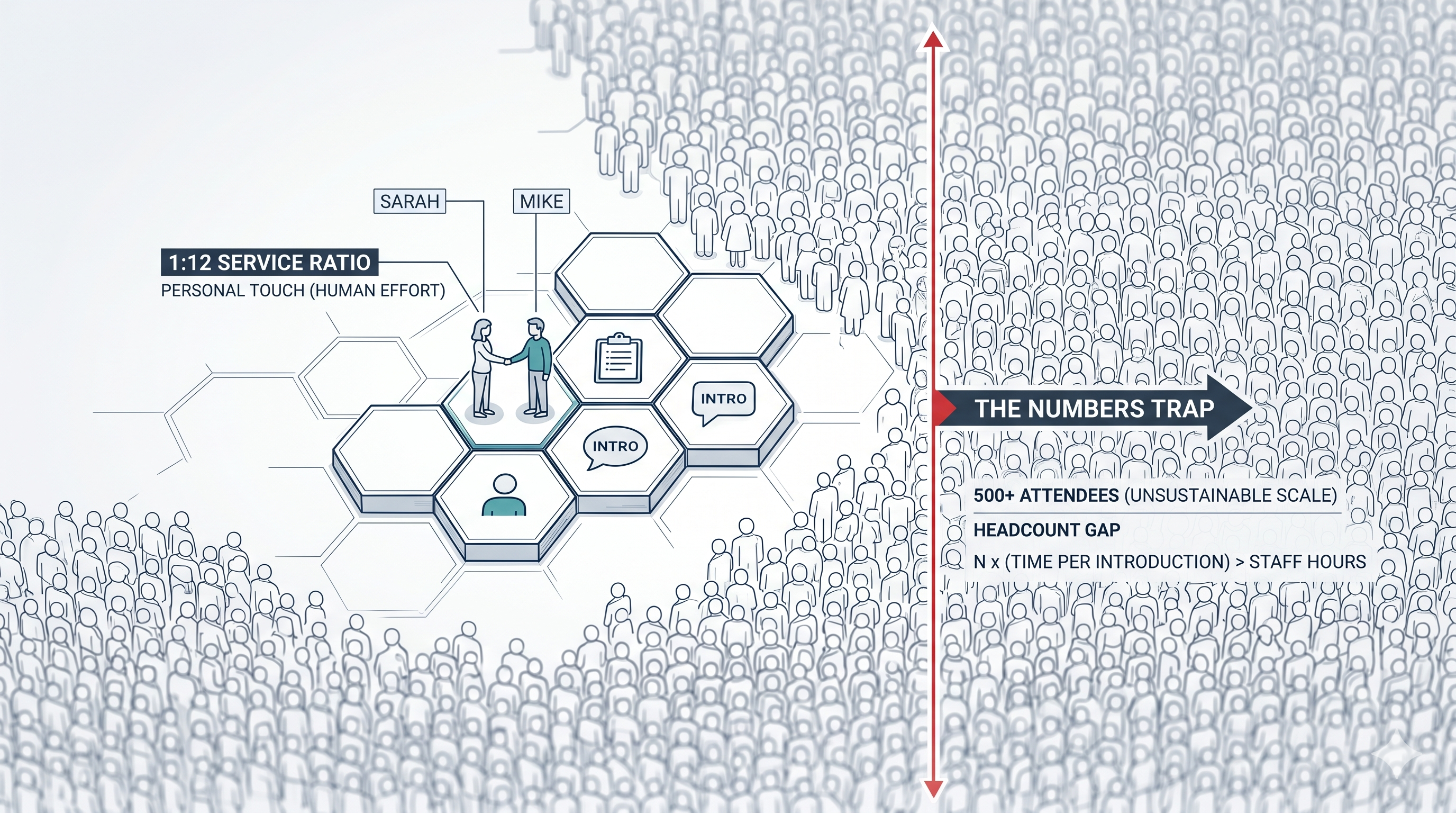
Premium events run at a staff-to-attendee ratio of around 1:12. At that level, staff can learn names, understand what someone came for, and make introductions that land. Push to roughly 1:40 and the quality starts to slip. Beyond that, staff stop anticipating and start reacting. They answer questions instead of preventing them. They handle complaints instead of avoiding them.
Now do the arithmetic on a 5,000-attendee show.
To hold even the 1:40 ratio where quality begins to erode, you need 125 people. To deliver the 1:12 service that actually feels personal, you need over 400. Few organisers can staff that, and fewer still can train and retain it. The maths gets worse the bigger your show gets.
This is the part worth sitting with. Somewhere between 500 and 1,000 attendees, personal attention through human effort alone stops being difficult and becomes impossible. Not expensive. Not hard. Structurally impossible. No budget closes the gap, because the gap is not made of money. It is made of headcount that does not exist and cannot be hired fast enough to matter.
Ade Allenby of Allenby Advisory puts it plainly: “You improve shows by selling connectivity, but you can’t do that without intelligence. You cannot hire a thousand salespeople to interview every visitor.”
You have probably felt this without naming it. The show grew, the team grew, and the experience somehow got less personal, not more. That was not a failure of the team. It was the maths doing exactly what maths does.
The escape hatch that isn’t one
At this point the usual move is to reach for technology. Get an app. Add a recommendation feature. Put a QR code on the badge.
Most of that is digitisation wearing personalisation’s clothing. An app that shows a static agenda has not personalised anything; it has put the printed programme on a phone. A badge scanner that counts booth visits without connecting them to anything has produced a number, not an insight. The attendee still gets the same experience as the 4,000 people standing next to them. You have spent money to make the generic feel slightly more modern.
Adam Parry of Event Tech Live draws the line where it actually sits: “I want systems to do 80% of the work so I can finesse the last 20%. AI handles the scale; humans provide the nuance.”
That is the distinction. The goal was never to remove your team from the personal touch. It was to stop asking them to do the 80% that no team of any size can do by hand, so they are free for the 20% that only a person can.
The question you have been asking is the wrong one
For years the industry has asked: how do we do more of this? More staff, more programmes, more effort, more spend.
The honest answer is that you cannot, and you were never going to be able to. The question has a ceiling built into it.
The better question is the one almost nobody asks: what would make personal attention possible at all, for every attendee, regardless of how many of them there are?
That is not a staffing question. It is an infrastructure question. And the answer has three parts. The data your show already collects has to be connected instead of scattered across registration, badge scans, the app, and the sponsor dashboard. Once connected, it has to be made sense of, so a pattern across 5,000 people becomes a recommendation for one. And then it has to act, reaching every attendee, not just the VIPs with a coordinator assigned to them.
Your show already generates almost all of the raw material. The registration system knows who someone is. The scanners know where they went. The session tracker knows what they sat through. Today those fragments sit in separate tools that never speak, which is why the qualified buyer who walked your floor stays invisible to the exhibitor who paid to meet exactly that person.
The personal touch at scale is not a harder version of what you already do. It is a different thing entirely, and it starts by treating the problem as infrastructure rather than effort.
Part II looks at what that infrastructure actually does once it exists, and what changes for every stakeholder in the room when it does.
This piece draws on Visual Hive’s research paper, The Personal Touch at Scale. Read the full paper, with sources, here: https://visualhive.co/intelligence/whitepaper/
Read this on LinkedIn