Visual Hive Blog
The Personal Touch at Scale (Part II): What Event Intelligence Actually Looks Like
By Visual Hive
Published
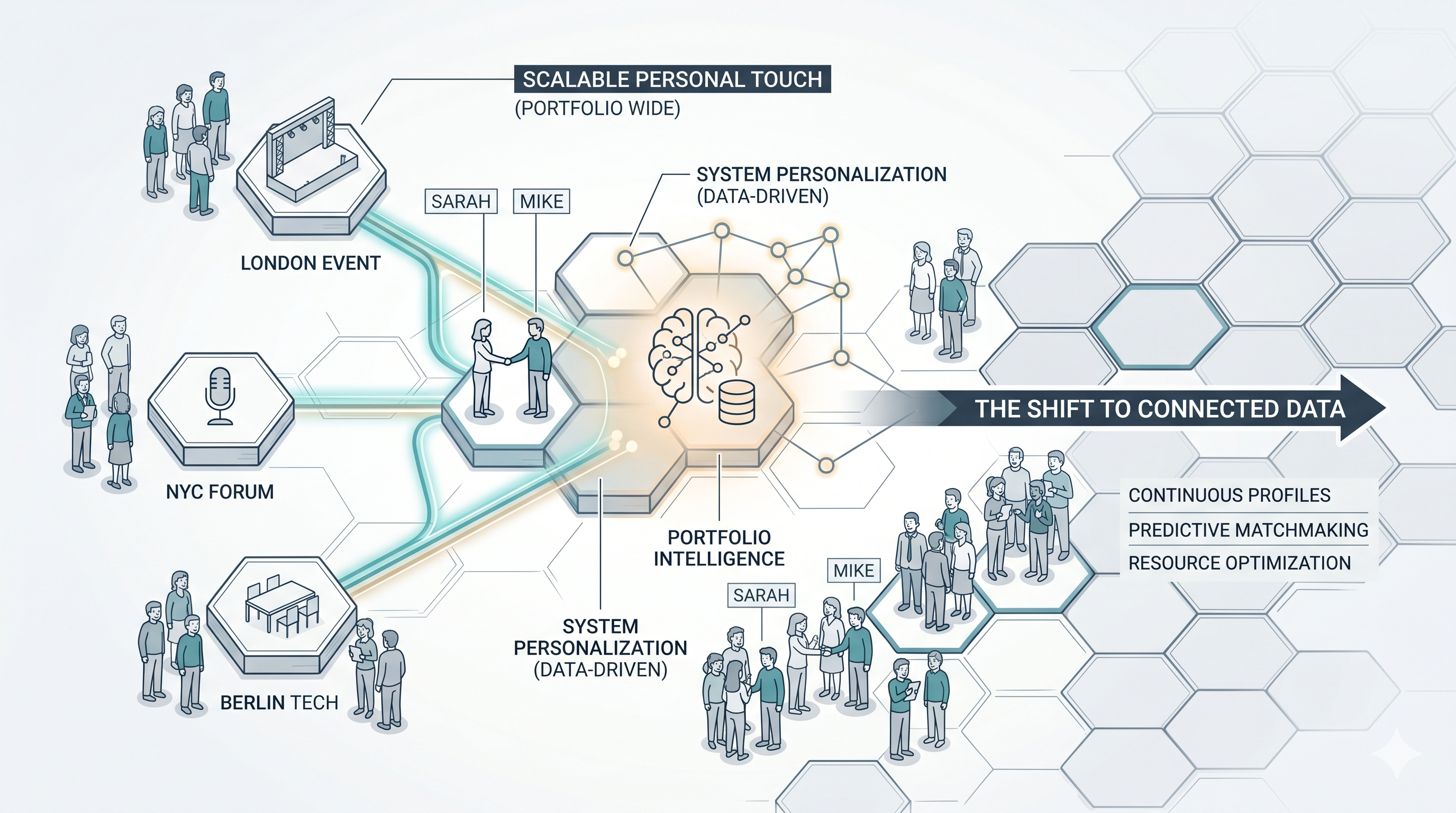
In Part I, the conclusion was uncomfortable: above roughly 500 attendees, personalising your tradeshow through human effort alone is not hard, it is impossible. The maths does not bend. No amount of staffing closes the gap.
So you do the sensible thing. You go looking for software.
And the market is delighted to see you. AI matchmaking. Recommendation engines. Personalisation platforms. Smart apps. Every booth at every event tech showcase promises the personal touch at scale, and after Part I, that is exactly what you are in the market for. It feels like the problem is about to be solved by procurement.
This is where it pays to slow down.
Most of what you will be sold is the surface
A large share of what gets called “AI personalisation” in tradeshows is a chatbot bolted onto a registration form. Or a badge scanner that logs a visit and connects it to nothing. Or an app that asks attendees their interests at signup and never touches those answers again.
These tools digitise the surface of your event. They do not connect what is underneath. And the value lives entirely underneath.
Here is the part the demos skip. The technology to personalise at scale largely exists. The reason it so rarely works is not the algorithms. It is that your data is in pieces. Registration sits in one system. Badge scans in another. Session attendance in a third. The sponsor dashboard is walled off from all of them. IDC research puts the cost of this at around 30% of potential revenue lost to data silos that block any cross-platform view.
The consequence is concrete and it happens at every show. A qualified buyer, someone who matches an exhibitor’s ideal customer profile exactly, walks the floor, visits three stands, and attends a session on precisely the topic that exhibitor sells into. The exhibitor never finds out. Not because the data did not exist, but because the four systems that each held one piece of it never spoke to each other.
You did not have a personalisation problem. You had a connection problem wearing a personalisation costume.
Connection is necessary. It is not the point.
So the next instinct is right but incomplete: connect everything. Integrate the systems. Build the single view.
Do it, and you have built something useful. But integration on its own just gives you a tidier pile of data. The question that actually matters is not “can I get all of this in one place?” It is “what happens the moment I can ask it a question?”
That is where the experience changes, and it changes differently for every person who walks through your doors.
For exhibitors, the shift is from random traffic to targeted engagement. Instead of a generic exhibitor manual, they get told that 247 registered attendees match their criteria and 89 of them are decision-makers, before the doors even open. Booth staff get alerted when a high-value prospect is in the hall, not told about them in a report two weeks later. AI-matched meeting requests run at around 39% acceptance, far above cold outreach. And the black box of return on investment opens: a dashboard showing lead quality and engagement depth, in time to act on it, instead of an aggregate PDF that lands long after anyone can use it. This is what moves an exhibitor from “we’ll see how it goes” to rebooking. It is the single metric your commercial director cares about most, and it is downstream of whether the exhibitor could prove what they got.
The other stakeholders move the same way. Attendees stop getting lost (a third of them currently do) and the 43% who said they wanted personalised recommendations actually receive them, so navigating your show becomes guided rather than guesswork. Sponsors get real attribution tied to outcomes instead of impression estimates nobody believes. And you, the organiser, get the thing underneath all of it: a credible path to 85% exhibitor retention and the 15 to 30% price premium that demonstrated value justifies.
None of these are projections. At Event Tech Live, this approach generated over €100,000 in new revenue for the organiser, facilitated 1,867 meetings, and drove a 65% email open rate. Those are not impressions or estimates. They are outcomes, attributable, and they would not have existed otherwise.
There is no comfortable middle ground
This is the choice the research keeps arriving at, and it is more binary than most of the industry wants to admit.
One model sells space at a price per square metre, delivers a roughly identical experience to everyone, reports aggregate numbers a few weeks late, and competes on venue, dates, and price. The other sells outcomes with documented return, delivers a different experience to each stakeholder, reports in real time, and competes on results and proof.
The honest read of the data is that the first model is not a stable place to stand. It is a slow decline dressed up as continuity. Every edition, the organisers building the second model pull further ahead, because their events get smarter while the square-metre shows stay exactly the same.
The question is no longer whether your shows make this transition. It is when. And the data says the answer is now, while the gap between the two models is still one you can cross rather than one that has already left you behind.
This is the problem Erleah was built to solve: connecting what your show already knows, and acting on it for every stakeholder, not just the few with a coordinator assigned. But the strategic point stands whichever way you get there. The personal touch at scale is no longer impossible. It just stopped being a question of effort, and became a question of infrastructure, and of timing.
This piece draws on Visual Hive’s research paper, The Personal Touch at Scale. Read the full paper, with sources, here: https://visualhive.co/intelligence/whitepaper/. If you have not read Part I, on why personalisation breaks above 500 attendees, start there.
Read this on LinkedIn